
At PixAI, we help people use AI to create their own anime and illustration artwork. Our users generate images, publish them to our community, and interact with art from other creators. As head of growth analytics, I keep an eye on all this activity, with a focus on which actions lead to dedicated, long-term users.
I’ve been using Amplitude Wave to go even deeper on that goal, to analyze context and uncover data-backed moves I can make to improve user retention. One recommendation from Wave led us to add a tooltip that appeared when users ran out of image generation credits. It pointed users to the Missions tab, where they can publish their work for other users to view and interact with.
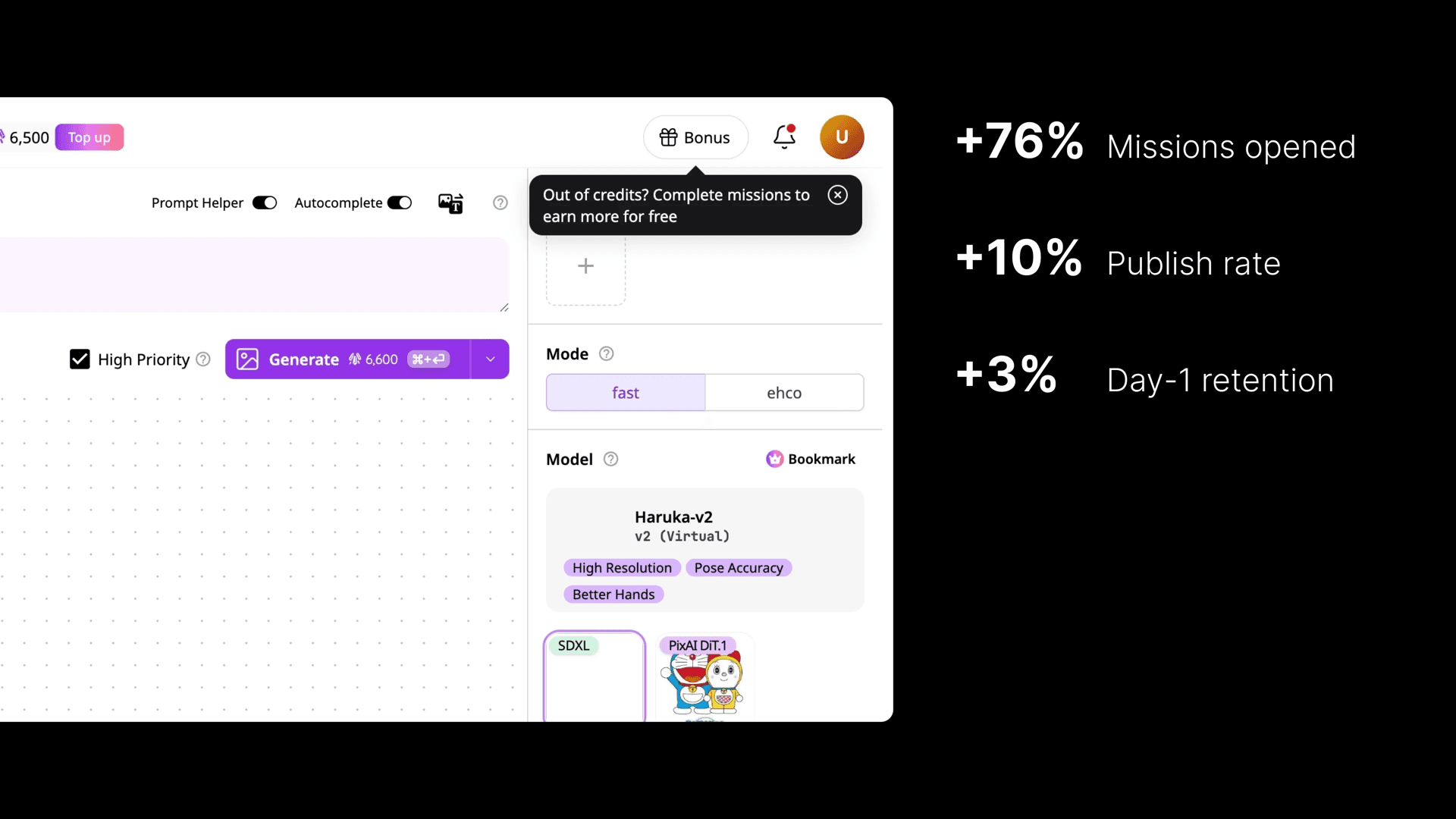
After we made that change, our publish rate increased nearly 10%. We also saw Day 1 retention rise 3% over control. We think publishing draws people into the community, and the extra credits help them keep creating.
Better Wave recommendations from better product context
When we joined the Wave beta earlier this year, activation was our main priority. Early in our experimentation, we discovered how important product context was in generating useful recommendations.
When Wave could analyze qualitative data as context, its visual mockups became much closer to the real PixAI environment. I wanted Wave to have that context across the product. So I asked an engineer to add that to the main parts of our product to give Wave more context to work with.
The mockups we generated after that helped us quickly understand new concepts and review potential growth opportunities. Seeing a suggestion come to life in a recognizable product screen made it easier to assess how users would be impacted by a change.
Identifying an opportunity for better retention
With that additional context, Wave identified a relationship between an in-product action (publishing artwork) and my goal metric (retention). Our hypothesis: Users who publish their work are more likely to come back and check for engagement from the community. That type of feedback is very rewarding for PixAI users.
What about new users? They were creating new art, but were largely left to discover the Publish button themselves. After generating an image, they didn’t see any clear invitation to share it. The activation chain breaks there. If they don’t publish their work, the community doesn’t see it, and the artist gets no engagement.
Wave discovered that opportunity and proposed testing a prompt to publish after image generation. It gave us two important things: 1) a specific behavior to encourage and 2) a specific point in the user experience to encourage that behavior.
Connecting publishing to more credits
Finding a correlation between publishing and retention gave us a reason to investigate the behavioral data. But that information wasn’t the end of the process. We still needed to decide how that recommendation should come to life inside PixAI and design a real experiment to see what would happen when we shipped it. Ultimately, we adapted Wave’s recommendation and tested a new tooltip that pointed users to the Missions tab, a part of our product that already rewards publishing.
PixAI users spend credits to generate images. One of the easiest ways for them to earn more credits is to publish daily artwork in the Missions tab. We want our new users to get more familiar with how that experience works, and we saw this experiment as a useful moment to introduce Missions. When a user ran out of credits, our tooltip could point them toward Missions, where they could publish, earn more credits, and keep creating.
We added a tooltip to the Missions tab. It would appear when a user ran out of image generation credits. The message was direct: “Out of credits? Complete missions to earn more for free.”
What changed after the tooltip
We ran this as an A/B test and measured whether users opened Missions and published artwork, then looked at Day-1 retention to see whether more users returned the next day.
The results were clear. Missions opens increased 76.7%, and our publish rate increased nearly 10%, both over control. We also saw a 3% increase in Day-1 retention. Wave pointed us to the right opportunities and our team decided how to act on it. But the biggest decision came from the people who knew our product best.
Wave found a correlation between publishing and retention, but its initial suggestion was to prompt publishing after generation. Our team decided to point users to Missions (where publishing was already rewarded) when they needed credits. We kept the behavior Wave had identified and used our knowledge of the existing credit system to give people a reason to try it.