Meet the Next Gen Builder: Carlos Gonzalez de Villaumbrosia, Founder and CEO of Product School
Join Francois Ajenstat, host of the Next Gen Builders podcast, and Carlos Gonzalez de Villaumbrosia, Founder and CEO of Product School, as they explore how to build high-growth communities.

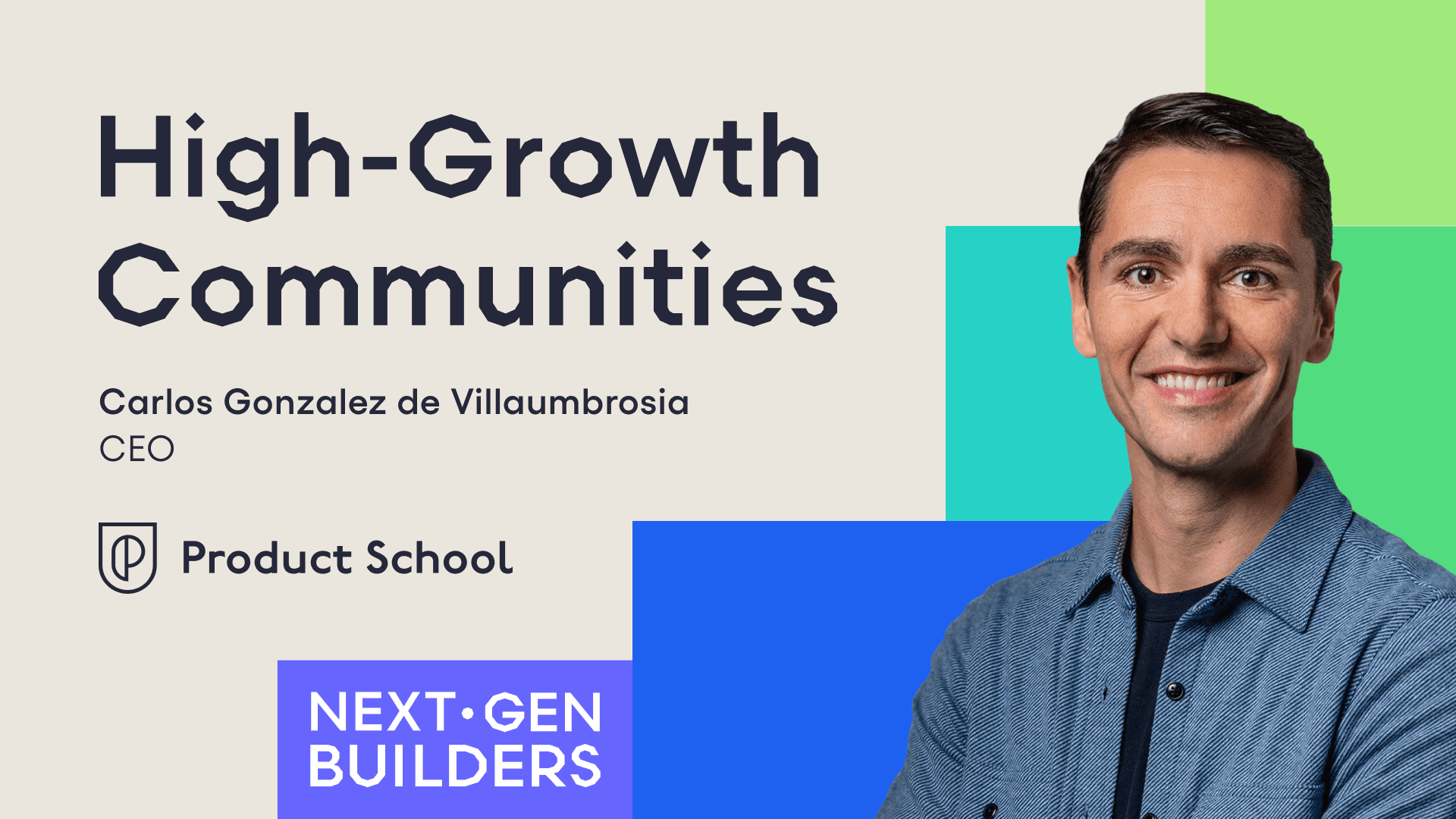
Eleven years ago, Carlos Gonzalez de Villaumbrosia was the first—and only—member of his community. He had a vision to democratize access to education for aspiring product managers who didn’t have the right mentors, instructors, or resources. So he built the school he wished he had—and grew it to over two million members worldwide.
Product School is now the global leader in product management training, but building it from the ground up came with its own set of challenges. In the inaugural episode of Next Gen Builders season 2, Carlos sits down with Francois Ajenstat to share his journey.
Listen to the episode on Apple Podcasts, Spotify, or YouTube.
Building a community from one to two million
Growing a product to millions of users requires pulling different growth levers, and a community is no different. In the early days, Carlos had no playbook to guide him—only a hypothesis that he decided to test on his own.
Carlos first started gaining traction by answering product questions that no one else was addressing in online forums. “I was lucky in a way,” he says. “I based this whole idea on an intuition with no data to back me up, yet I was finding an early version of product-market fit. There were enough people who cared about the same problem that I had.”
Next, Carlos began hosting scrappy weekly events in San Francisco. He covered different product management topics and consistently drew 50–100 attendees per event. This eventually led to the next step in his growth journey: monetization.
Carlos launched paid online trainings—with himself as the first instructor—and reached his first 1,000 users. After running solo for two years, he started recruiting other product leaders to teach, giving him time to refocus on community building.
Carlos leaned into his belief that community isn’t transactional. It’s about creating connection and value between members, often for free, without expecting to get something in return. Product School began offering even more events, resources, and templates at no cost. That goodwill turned into incredible growth momentum as product leaders could contribute to the industry in new ways while community members received upfront value.
Building a community is a strategy, not a tactic. It’s about building something for the long term.
Carlos Gonzalez de Villaumbrosia, Founder and CEO of Product School
The hallmarks of great product leaders
A major growth lever in scaling the Product School community was founding and hosting The Product Podcast, where Carlos has interviewed over 260 product leaders. These conversations revealed key traits that consistently set top product leaders apart:
- Doer mentality: “Executives are doers—and that’s the number one thing that sets the tone,” says Carlos. There’s no replacement for rolling up your sleeves, staying close to the details, and understanding the business from every angle.
- Revenue ownership: Carlos sees the role of chief product officers (CPOs) evolving to own the revenue number and drive the business forward. “There’s a shift from CPOs building technology to connecting it to go-to-market,” he notes. That means understanding product expansion, competitive intelligence, and business models—not just user satisfaction.
- Accountability: Product leaders are accountable for business outcomes, including revenue growth. “I expect leaders to embrace that accountability not to the detriment of their users, but as a way to validate that what they are building is something that users will love and pay for,” explains Carlos.
Learn more about what top product leaders have in common by tuning in to The Product Podcast.
Navigating digital AI transformations
Digital transformations happen all the time, but over 70% of them fail. Product School has helped many companies navigate their transformations, and Carlos shares four key tips for success:
- Start before it’s too late: Most companies embark on a digital transformation because the business is already struggling. But the best transformations happen when teams are proactive and not afraid of change, even when things are going well.
- Involve the CEO and managers: Top-down commitment is critical. Carlos expects executives to model the transformation behavior while managers reinforce it. Delegating to individual contributors without this support rarely works.
- Empower your people: Any transformation is ultimately a people transformation. Be transparent with your team about what AI means for them and how they can benefit from the changes. Transparency is highly motivating, especially when the CEO pushes the message from the top and managers evangelize it down.
- Treat it like a product: “A transformation implies that you go from ‘A’ to ‘B’ and are done, while in reality, it’s an iteration,” explains Carlos. Companies that succeed won’t treat their transformation like a one-time project. They’ll define their key initiatives and success criteria ahead of time, then put the right processes, technology, and tracking in place to improve.
Tune in to Carlos’s story
Carlos’s journey from a solo founder to the leader of Product School’s two-million-member community is a masterclass in how to build from scratch, iterate quickly, and create long-lasting value. Whether you’re scaling a new product, leading a product team, or navigating a digital transformation, you’ll find even more lessons in his full episode.
Want to make sure you don’t miss an episode of Next Gen Builders? Subscribe today.

Brynn Haynam
Sr. Director, Brand Marketing, Amplitude
Brynn Haynam is a brand builder who's always had a passion for the intersection of art and data, and for building world-class creative teams. Before Amplitude, Brynn built and led a brand team at Medallia and helped grow the business from startup to a publicly traded company.
More from BrynnRecommended Reading

I was the bottleneck
Sep 10, 2026
8 min read

Your agents are only as good as your data context
Sep 4, 2026
9 min read

The New Trust Economy in Financial Services
Sep 2, 2026
11 min read

How to Secure AI Agent Traces Without Losing the Signal
Aug 28, 2026
7 min read