Platform

AI

Amplitude AI
Analytics that never stops working
AI Agents
Sense, decide, and act faster than ever before
AI Feedback
Distill what your customers say they want
Amplitude MCP
Insights from the comfort of your favorite AI tool
Agent Analytics
Measure the real impact of your agents
Early Access Program
Test new AI features before they launch

Insights

Product Analytics
Understand the full user journey
Marketing Analytics
Get the metrics you need with one line of code
Session Replay
Visualize sessions based on events in your product
Heatmaps
Visualize clicks, scrolls, and engagement
Zoning Insights
Overlay performance and revenue metrics on your webpages

Action

Guides and Surveys
Guide your users and collect feedback
Feature Experimentation
Innovate with personalized product experiences
Web Experimentation
Drive conversion with A/B testing powered by data
Feature Management
Build fast, target easily, and learn as you ship
Activation
Unite data across teams

Data

Data Governance
Complete data you can trust
Integrations
Connect Amplitude to hundreds of partners
Security & Privacy
Keep your data secure and compliant
Solutions
Solutions that drive business results
Deliver customer value and drive business outcomes
Amplitude Solutions →

Industry

Financial Services
Personalize the banking experience
B2B
Maximize product adoption
Media
Identify impactful content
Healthcare
Simplify the digital healthcare experience
Ecommerce
Optimize for transactions

Use Case

Acquisition
Get users hooked from day one
Retention
Understand your customers like no one else
Monetization
Turn behavior into business

Team

Product
Fuel faster growth
Data
Make trusted data accessible
Engineering
Ship faster, learn more
Marketing
Build customers for life
Executive
Power decisions, shape the future

Size

Startups
Free analytics tools for startups
Enterprise
Advanced analytics for scaling businesses
Resources

Learn

Blog
Thought leadership from industry experts
Resource Library
Expertise to guide your growth
Compare
See how we stack up against the competition
Glossary
Learn about analytics, product, and technical terms
Explore Hub
Detailed guides on product and web analytics

Connect

Community
Connect with peers in product analytics
Events
Register for live or virtual events
Customers
Discover why customers love Amplitude
Partners
Accelerate business value through our ecosystem

Support & Services

Customer Help Center
All support resources in one place: policies, customer portal, and request forms
Developer Hub
Integrate and instrument Amplitude
Academy & Training
Become an Amplitude pro
Customer Success
Drive business success with expert guidance and support
Product Updates
See what's new from Amplitude

Tools

Benchmarks
Understand how your product compares
Prompt Library
Prompts for Agents to get started
Templates
Kickstart your analysis with custom dashboard templates
Tracking Guides
Learn how to track events and metrics with Amplitude
Maturity Model
Learn more about our digital experience maturity model
Event Taxonomy Generator
Create a clean and custom event taxonomy for your website
Pricing
LoginContact salesGet started

AI

Amplitude AIAI AgentsAI FeedbackAmplitude MCPAgent AnalyticsEarly Access Program

Insights

Product AnalyticsMarketing AnalyticsSession ReplayHeatmapsZoning Insights

Action

Guides and SurveysFeature ExperimentationWeb ExperimentationFeature ManagementActivation

Data

Data GovernanceIntegrationsSecurity & Privacy
Amplitude Solutions →

Industry

Financial ServicesB2BMediaHealthcareEcommerce

Use Case

AcquisitionRetentionMonetization

Team

ProductDataEngineeringMarketingExecutive

Size

StartupsEnterprise

Learn

BlogResource LibraryCompareGlossaryExplore Hub

Connect

CommunityEventsCustomersPartners

Support & Services

Customer Help CenterDeveloper HubAcademy & TrainingCustomer SuccessProduct Updates

Tools

BenchmarksPrompt LibraryTemplatesTracking GuidesMaturity ModelEvent Taxonomy Generator
LoginSign Up

Why it’s safe to send agent traces

Role-based access and privacy redaction are on by default. Take advantage of enterprise-grade controls when sending traces to Amplitude Agent Analytics.
Product

Aug 28, 2026

7 min read

Nhi Dao

Staff Software Engineer

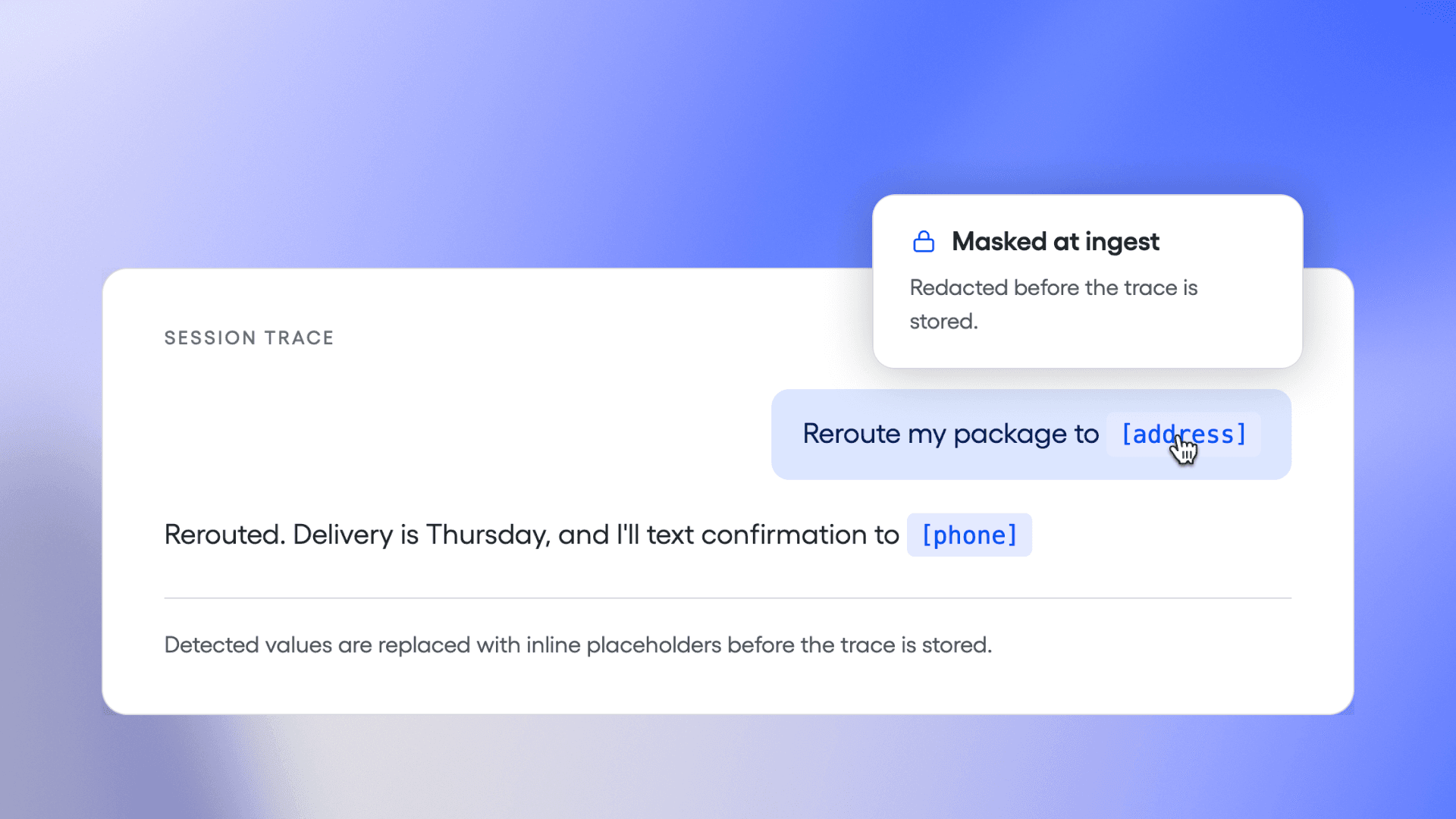
Session trace with address and phone number replaced by inline placeholders, labeled 'Masked at ingest.'

Agent traces hold the rawest data in your stack. The exact words a user typed, the model's reply, the arguments passed to every tool, the state that moved between spans. That’s precisely why teams hesitate to send them anywhere, and why “let’s not pipe trace data into another system” is the most common objection we hear about Agent Analytics.

So we built Agent Analytics so you can control what leaves your app, who can see it, and how long it lives. And the part most people miss: you keep the signals, evaluators, and cohorts even when the sensitive text never crosses the wire. Governance should not cost you the insight.

Who can see a trace: role-based access control

Access to Agent Analytics runs through Amplitude’s role-based access control. Three permissions gate the product:

  • View Agent Analytics Objects lets a role open sessions, evaluators, and related objects. A role needs this to use the product at all.
  • Manage Inactive Evals and Runs lets a role create evaluators and launch dry runs.
  • Activate Evals lets a role turn an evaluator live or archive one.

You decide which roles carry which permission, so a support analyst can read sessions while only your ML leads can push an evaluator into production.

That same model governs our own AI features. They respect the permissions and data access controls already set up in your account. No new data access is granted to a user when an AI feature runs. An agent acting on your behalf can only touch data you are already authorized to see, and it cannot escalate past your permissions. Administrators can audit user inputs and agent outputs, so there is a record of what was asked and what was returned. You set access. It isn’t inherited.

What leaves your app: PII redaction and privacy modes

The real worry about traces is the free text. A user drops a phone number into a support chat, and now it’s sitting in your analytics. Agent Analytics handles this at the SDK level, before data leaves your infrastructure, through a privacy mode you set.

There are three modes:

  • full is the default, and it sends prompt and response text with Personally Identifiable Information (PII) redaction on by default. This is completely configurable and extensible by customers. You can redact as needed beyond the out of the box PII scrubbing rules that the SDK ships with.
  • metadata_only sends tokens, latency, model, and cost, and no text at all, which is the setting for regulated or sensitive workloads.
  • customer_enriched sends pre-scored summaries from your own evaluation stack and nothing else.

Some examples of fields we redact by default are Email, Phone, Credit Card, SSN, IP Address. When these values are sent into Amplitude Agent Analytics, the resulting traces will show those as [email], [phone], [credit_card], [ssn], [ip_address] so the actual values are obfuscated.

The text-bearing fields: the message text, tool inputs and outputs, span input and output state, the system prompt, reasoning content, only ship when the privacy mode permits. Attachments come through as metadata only, never file content. Even tool definitions can stay private: we send a stable hash of your tool schema so you can detect a toolset change, without exposing the schema itself.

Agent Analytics doesn’t need PII to work. Redactions of PII values do not impact the actual out of the box signals or custom evaluations (evals). We run its always-on signals on every closed session: task completion, response quality, user friction, user intent, session safety, and a code-based data quality check. Session safety alone classifies each session as Normal, Off Topic, Prompt Injection, Abuse, Probing, Unsafe Output, or Data Leak. Your own evaluators, whether rule-based or LLM-as-judge, run on top. All of that enrichment reads structure and permitted fields, so you see that a billing session failed task completion and tripped a friction signal without ever seeing the customer’s number. You mask the sensitive value but keep the quality picture.

The trust layer underneath all of it

More than 4,900 companies and 26% of the Fortune 100 run on Amplitude, and over 2,000 trust it with their data. We run GDPR, CCPA, and HIPAA programs, will sign a Business Associate Agreement for covered entities, and self-certify under the EU-US Data Privacy Framework. Data lives in AWS, in the US or in the EU Frankfurt region if you need EU residency, on infrastructure certified to ISO 27001 and SOC 2 Type II. The full certification set is in the Customer Trust Portal.

The AI side is just as strict. We contractually prohibit our AI partners from training on your data. Workflows on AWS Bedrock keep your data inside Amplitude’s AWS environment, where the model providers never receive it. Workflows that use OpenAI or Google run through Zero Data Retention endpoints. If you provision in the EU data center, your data never leaves the EU when you use Amplitude AI.

The proof is in who already sends sensitive data here. ClearScore, which handles credit data for millions of people, is the case study Amplitude features on its own security page. Salt Bank built a digital bank on Amplitude and beat its launch targets by 2x. ACKO, a digital insurer, drove 13% more conversions and cut support calls in half with GenAI measured in Amplitude. The Economist Group put a hard number on its AI quality using the same approach Agent Analytics runs on.

Connecting agent performance to business outcomes

Keeping traces locked in a standalone observability tool feels safer, but it strands the one thing that matters most: the connection between agent quality and business outcomes. Because agent sessions share Amplitude user identity with your product events, you can build a cohort of users whose sessions failed task completion and chart their 30-day retention against users whose sessions succeeded. Pure observability tools cannot make that join. That is the reason to send the data, and the controls above are what make it safe.

We've open sourced the privacy/scrubbing patterns here and can expand on that over time to automatically package them in the SDK.

Get started today → Instrument Agent Analytics in minutes


Ready to use AI to transform your product?

Amplitude Agents help you understand your users more easily than ever.

Get started now
About the author

Nhi Dao

Staff Software Engineer

More from Nhi

Nhi Dao is a Staff Software Engineer at Amplitude.

More from Nhi
Topics

AI

Agents

Analytics

Privacy

Recommended Reading

article card image
Read 
Product
Connecting Agent Performance to Product Outcomes

Aug 20, 2026

10 min read

article card image
Read 
Customers
The Hidden Cost of a Bad AI Answer

Aug 19, 2026

6 min read

article card image
Read 
Insights
Verification loops in software factories: What PMs need to know

Aug 19, 2026

11 min read

article card image
Read 
Product
Your AI Chat Box Isn't a Strategy. Where You Put It Is.

Aug 18, 2026

11 min read

Platform
  • AI Agents
  • Agent Analytics
  • AI Feedback
  • Amplitude MCP
  • AI Assistant
  • Product Analytics
  • Web Analytics
  • Feature Experimentation
  • Feature Management
  • Web Experimentation
  • Session Replay
  • Guides and Surveys
  • Activation
Compare us
  • Adobe
  • Google Analytics
  • Contentsquare
  • Fullstory
  • Heap
  • LaunchDarkly
  • Mixpanel
  • Optimizely
  • Pendo
  • PostHog
Resources
  • Resource Library
  • Blog
  • Agent Prompt Library
  • Product Updates
  • AI Early Access Program
  • Amp Champs
  • Amplitude Academy
  • Events
  • Glossary
  • Free Chart Maker
Partners & Support
  • Status
  • Contact Us
  • Customer Help Center
  • Community
  • Developer Docs
  • Partner Program
  • Partner Directory
  • Become an affiliate
Company
  • About Us
  • Careers
  • Press & News
  • Investor Relations
  • Diversity, Equity & Inclusion
View markdown
Terms of ServicePrivacy NoticeAcceptable Use PolicyLegal
EnglishJapanese (日本語)Korean (한국어)Español (LATAM)Español (Spain)Português (Brasil)Português (Portugal)FrançaisDeutsch
© 2026 Amplitude, Inc. All rights reserved. Amplitude is a registered trademark of Amplitude, Inc.
Blog
InsightsProductCompanyCustomers
Topics

101

AI

APJ

Acquisition

Adobe Analytics

Agents

Amplify

Amplitude AI

Amplitude Academy

Amplitude Activation

Amplitude Agent Analytics

Amplitude Analytics

Amplitude Audiences

Amplitude Community

Amplitude Feature Experimentation

Amplitude Full Platform

Amplitude Guides and Surveys

Amplitude Heatmaps

Amplitude Made Easy

Amplitude Session Replay

Amplitude Web Experimentation

Amplitude on Amplitude

Analytics

B2B SaaS

Behavioral Analytics

Benchmarks

Churn Analysis

Cohort Analysis

Collaboration

Consolidation

Conversion

Customer Experience

Customer Lifetime Value

Customer Support

DEI

Data

Data Governance

Data Management

Data Tables

Digital Experience Maturity

Digital Native

Digital Transformer

EMEA

Ecommerce

Employee Resource Group

Engagement

Engineering

Event Tracking

Experimentation

Feature Adoption

Financial Services

Funnel Analysis

Getting Started

Global Agent

Google Analytics

Growth

Healthcare

How I Amplitude

Implementation

Integration

Kimi

LATAM

LLM

Life at Amplitude

MCP

Machine Learning

Marketing Analytics

Media and Entertainment

Metrics

Modern Data Series

Monetization

Next Gen Builders

North Star Metric

Open-Weight AI Models

Partnerships

Personalization

Pioneer Awards

Privacy

Product 50

Product Analytics

Product Design

Product Management

Product Releases

Product Strategy

Product-Led Growth

Recap

Retention

Revenue

Startup

Tech Stack

The Ampys

Warehouse-native Amplitude