Amplitude climbs to #3 in G2 Digital Analytics Momentum
Amplitude rose four spots in G2's Fall 2026 reports. Customers say it comes down to who gets to ask the questions.

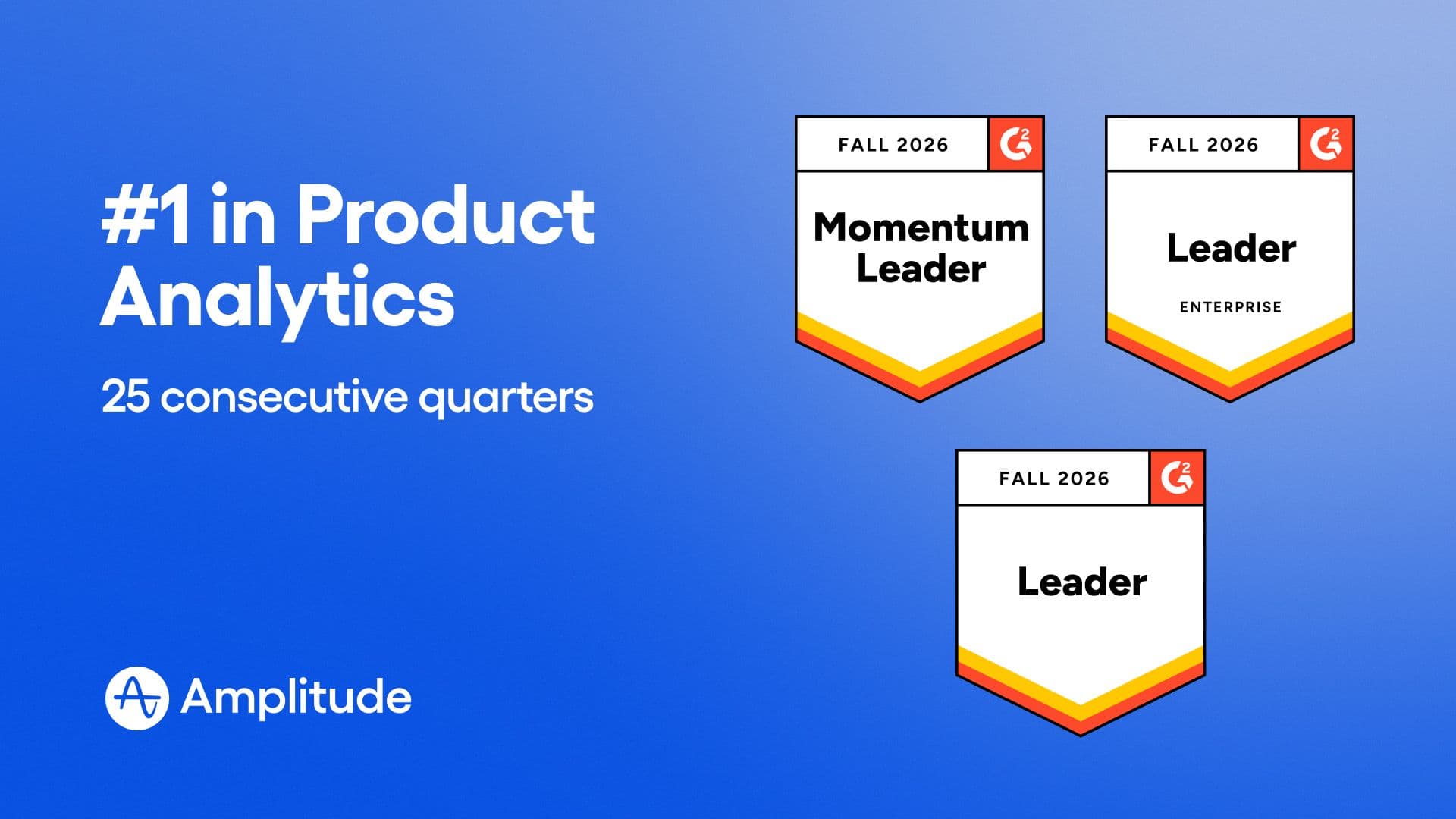
Last quarter, we predicted Amplitude’s gains in G2’s regional Digital Analytics rankings would extend to the global rankings. In the Fall 2026 reports, Amplitude rose from #7 to #3 on the Digital Analytics Momentum Grid. We also held #3 on the overall Digital Analytics Grid for the 4th quarter in a row and #1 in Product Analytics for a 25th consecutive quarter.
Digital Analytics is Google Analytics' category, and Adobe's. To understand why customers choose Amplitude instead, we looked at their explanations about things like answering questions without an analyst’s help and analyzing user behavior in more depth.
APAC and India, three months later
Amplitude now places #3 or better in 12 of the 17 Digital Analytics reports covering APAC, India, and ANZ, and nowhere below #5. A quarter ago that same set ran from #2 all the way down to #9.
|
Region (Digital Analytics) |
Summer 2026 |
Fall 2026 |
|
Mid-Market Asia |
#5 |
#3 |
|
Mid-Market Asia Pacific |
#5 |
#3 |
|
Mid-Market India |
#8 |
#3 |
|
Small-Business Asia |
#9 |
#5 |
|
ANZ |
#3 |
#3 |
Across all 66 Digital Analytics reports, Amplitude maintained or improved position in 55 of them. Some of the most notable gains occurred in Small Business LatAm (8→5), Mid-Market MEA (6→3), and the Small Business Grid Report (7→4). The energy we have been seeing in Asian markets is spreading globally.
These rankings don’t establish changes in market share or tell us why customers switched. For that, we looked at what reviewers said about their previous tools.
Why do companies switch from Google Analytics to Amplitude?
Of the 169 published G2 reviewers who named a previous tool in the last two years, 53 came from Google Analytics. That's 31%, more than three times any other product, and more than every dedicated product analytics competitor combined.
Thirty-three of the reviewers who switched explained why. They talked about the tool being usable by people who aren't analysts and depth of behavioral analysis, i.e. events, cohorts, funnels, retention.
None of the 33 mentioned cost as a reason for switching.
A user acquisition marketer at a health and fitness company described the friction: "GA4 required a lot of setup and tagging to answer even simple user journey questions, and the data model made it harder to create flexible cohorts or run retention analyses." Read their review on G2.
A growth marketing manager at a marketing services firm in India described working independently: with Amplitude "you can slice, filter, and pivot data without needing to rely on SQL or analysts for every question."
What does self-serve analytics actually look like?
It looks like more of the company answering its own questions. Two customers who left legacy analytics published their accounts, and they were stuck in opposite ways: one couldn't get answers out of the tool, the other couldn't get enough people into it.
Nederlandse Spoorwegen (NS), the Dutch national railway, hit a technical wall. Niels van Dijken, their Data and Customer Experience Optimization Expert, describes GA4 as "difficult for non-technical users, limiting its use across marketing and other teams." Advanced analysis meant BigQuery and SQL, so most people didn't do advanced analysis.
"If I wanted to go in depth, I had to go to BigQuery and write SQL queries. With Amplitude, it's very simple to create a funnel, set timers on funnels, and build segments." — Niels van Dijken, NS
NS now runs about 60 experiments a year, generating roughly €2.4M in annual business value. Over two years, tests that failed have headed off another €1.8M in losses on changes that never shipped.
A top automotive marketplace hit the opposite wall. The company, which published its story anonymously, had run on Adobe Analytics for over a decade while serving 25 million monthly visitors. Its lead analyst put the problem in one number: the platform "was so complex that only a handful of specialized analysts could effectively use it — just 10, to be precise."
Every other department depended on those 10 analysts for answers.
Within months of moving to Amplitude, more than 100 team members were using it. Funnel analysis surfaced a "Check Availability" button that users misread, leaving fields blank and triggering errors. Two small fixes later, submissions rose 6% and error rates fell 30%.
Other reviewers describe the same ability to work independently. A data product manager at a Brazilian software company says the best thing about Amplitude is how easy it is to work with data, make decisions, and analyze results quickly without relying on a development team. Read their review on G2.
The sharpest version came from a data analyst at an enterprise financial services company who had just left Adobe Analytics:
"It's built from the ground up to help you answer questions that you didn't even know you could answer."
When is Google Analytics still the better choice?
Google Analytics is free for most use cases and genuinely good at what it was built for: traffic, acquisition channels, marketing attribution. The automotive marketplace ran on Adobe for more than a decade before the bottleneck outweighed the benefit. These are capable tools, not bad ones.
One director of product management gave us four stars and said: "Amplitude doesn't have much as far as prepackaged reporting. So if you're coming from a tool like GA4 be prepared to recreate all of the basic reporting that you get out of the box from GA4 or most other platforms."
That matches our own G2 data, where we rank below our Grid position on implementation. Event-based analytics makes you decide what to measure; GA's automatic page tracking doesn't ask that of you. The thinking happens up front instead of never. The setup is the feature.
The financial services analyst quoted above wrote something else in the same review: "The learning curve is high. Shifting from Adobe, the UI takes time to get used to."
The same reviewer gave Amplitude five stars while describing a steep learning curve. Their experience is a useful reminder to evaluate both what your team will be able to do and how much work it will take to get there.
The question you don't ask is the one that costs you
Legacy analytics answers the question you configured it to answer. Ask a different one and you're filing a ticket, writing SQL, queuing behind ten specialists, or quietly deciding the question wasn't important.
Decisions aren't usually lost on the first question. They're lost on the fourth, the follow-up nobody asked because asking was too expensive. If a question costs three days and a ticket, you ask it three times a quarter instead of three times a day. Then you stop noticing you're not asking.
NS found that showing travel restrictions earlier in checkout helped conversion, while the same message later hurt it. Nobody sets out to test that. You get there by following the thread.
So if you're evaluating vendors, don't ask which reports come out of the box. Ask what happens when someone wants an answer nobody built a report for.
The automotive marketplace's lead analyst put it best: "When you remove barriers to data access, people naturally gravitate toward solving problems… the real breakthrough happens when teams feel empowered to question, investigate, and improve the user experience on their own terms."
Frequently asked questions
Is Amplitude better than Google Analytics?
They're built for different questions. Google Analytics is designed for web traffic, acquisition channels, and marketing attribution, and it does that well at low or no cost. Amplitude is built for event-level behavioral analysis: funnels, cohorts, retention, and experimentation across web and mobile. Teams that need to understand in-product behavior rather than traffic volume generally find Amplitude a better fit. Among Amplitude's own published G2 reviewers who named a previous tool, 31% came from Google Analytics.
Why do companies switch from Adobe Analytics to Amplitude?
The most common reason is access. Adobe Analytics is powerful but specialist-operated, which concentrates analysis in a small team and creates a request queue for everyone else. One automotive marketplace with 25 million monthly visitors ran on Adobe for over a decade with only 10 analysts able to use it effectively; within months of moving to Amplitude, more than 100 employees were building their own dashboards and running their own analyses.
How hard is it to migrate from Google Analytics to Amplitude?
The main work is defining an event taxonomy: deciding which user actions to track and how to name them. Unlike GA's automatic page tracking, event-based analytics requires deliberate instrumentation up front. Customers report that rebuilding GA's out-of-the-box reports is an easy part of the job to underestimate.
What should I ask an analytics vendor before switching?
Ask what happens when someone on your team wants to answer a question nobody built a report for, not which reports ship out of the box. Most major platforms ship comparable pre-built reporting. The real difference is whether a non-analyst can run an unplanned query without filing a ticket, and that capability rarely appears on an RFP checklist.
How did Amplitude rank in G2's Fall 2026 Digital Analytics reports?
Amplitude rose from #7 to #3 on the Digital Analytics Momentum Grid and held #3 on the overall Digital Analytics Grid for a fifth consecutive quarter. Across APAC and India it now places #3 or better in 12 of 17 regional Digital Analytics reports, and nowhere below #5, having ranged from #2 to #9 a quarter earlier. Amplitude also held #1 in Product Analytics for a 25th consecutive quarter.

Ashlyn Warblow
Sr. Customer Marketing Manager
Ashlyn Warblow is a Customer Advocacy and Marketing professional dedicated to building relationships and highlighting the stories that matter most. She finds energy in bringing people together, celebrating their successes, and creating programs that help them grow. Her favorite part of the work is cheering others on and helping their stories shine.
More from Ashlyn


