How to choose the right tracking plan template
Tracking plan templates can be huge-time savers, but they are not all the same. Here’s what to look for when selecting one for your organization.

Editor’s note: this article was originally published on the Iteratively blog on March 31, 2021.
Here at Amplitude, we believe that data is a team sport and building an analytics culture is an ongoing process. Tracking plans should be collaborative by nature, helping your business organize a single source of truth on what matters to your business.
A few companies have already created their own templates to use when getting started with a tracking plan. These templates allow you to reduce the headaches involved in creating a tracking plan from scratch.
However, static tracking plan templates do have their limitations. There is no way to enforce that what’s in the plan is actually in the product, often leading to a mis-match between the events and properties you see in your tracking plan and what is actually instrumented (which is why it’s a best practice to use platforms with built-in data governance features). But with the right process in place, organizations can easily overcome such challenges with static tracking templates.
Determine what you need to track
Tracking plans are like shoes. They come in different sizes yet serve the same purpose. They should be unique to your business and help you answer questions about what you are trying to achieve.
A good tracking plan will answer these central questions:
- What are the metrics that matter to our business?
- What data is needed to answer those metrics?
- How should we structure data to easily answer those metrics?
- How can we ensure the data being captured is trustworthy?
When putting together a tracking plan, start by listing your goals, followed by outlining your metrics and determining what events and properties you need to report on that metric properly. If your goals, metrics, and events are not aligned, you’ll likely end up tracking data not necessary to your business and missing out on events that are crucial to your organization.
Pick the right tracking plan template based on your needs
There are plenty of tracking plan templates out there, and some of them are designed with specific industries in mind. Here are a few must-have features and areas where you should customize your tracking plan.
What to look out for:
- A tab that contains overall business objectives and key performance indicators (KPIs)
- Columns for event name, description, property name, property type, source, version, owner, platform, side (client or server), priority level, and code snippet
- Sample data that can help you determine what to start with
- Detailed instructions on how to get started with that tracking plan
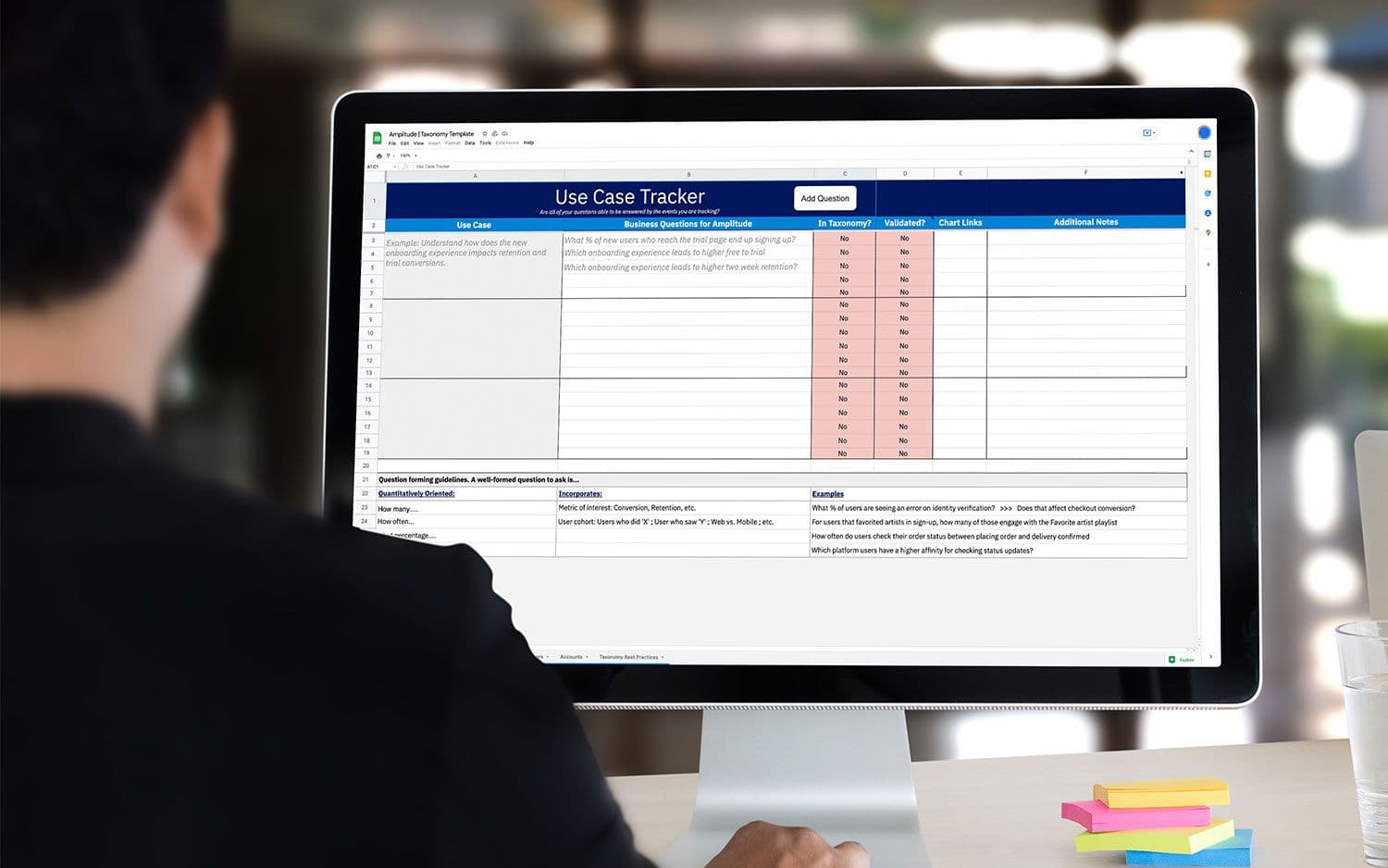
- Question-forming guidelines such as the following example from one of our templates: “For users that favorited artists during sign-up, how many of those engaged with the favorite artist’s playlist?”
What to customize:
- Events, descriptions, sources, and properties that align with your overall KPIs
- Your overall business objectives to help your team stay on track
Tracking plan templates for any industry
Here at Amplitude we’ve created a tracking plan template that works across industries. One of its most popular features is a use-case tab that helps users craft well-formed questions to home in on their most critical metrics.
We’ve also created a template that includes suggested events and properties for companies in the e-commerce industry. This is a great resource to use when getting started with a tracking plan, and it can easily be built out at a later time.
Determine who should own your tracking plan
Once you have your template in place, you can assign it an owner. But why should you assign ownership over the tracking plan? If too many stakeholders are involved, it becomes shared and does not have a team or individual owner who takes full responsibility.
The owner is empowered to drive results from the data, leading to accountability and, ultimately, users trusting the data. Who owns the tracking plan usually depends on the industry and the size of the company. In most cases, the product team is best positioned to do this, as event tracking should be tied to every product launch.
Make the event tracking plan part of your development process
Of course, even the best plan will be foiled by a lack of buy-in. In order to truly make analytics tracking part of your development process, you’ll need buy-in from leadership and all the relevant stakeholders. How do you do this? To generate buy-in, invite all key stakeholders to help determine the tracking process. You need everyone on board as you make data governance a part of your culture.
The limitations of static tracking plan templates
While tracking plan templates are a good place to start, they do have their limitations:
- Hard to keep up to date: Since it doesn’t live alongside your workflow, the template often gets lost in the mix. Updates are forgotten and it becomes unclear whether tracking was implemented or not.
- Hard to version: Tracking plans can become very complex and hard to manage as more people get involved. With more people involved, the list of potential problems grows, such as someone overwriting another user’s changes. The good news: Amplitude’s data governance features make versioning as easy as it is in Git.
- There is no way to enforce that what’s in the plan is actually in the product: This situation happens quite often, and it might even sound familiar. This problem occurs when there is a lack of culture around analytics tracking, and it is pushed aside. Note: Amplitude helps you ditch your static tracking plan by with features to enforce the schema in code, ensuring it is not ignored by developers.
Start tracking with Amplitude today
Templates are a great place to get started if you are new to implementing tracking plans. However, note that static templates do not solve the problem of making a tracking plan part of the developer workflow. That’s why Amplitude offers data governance features that integrate directly into your organization’s workflow.
Use a free static tracking template to get started, and book a demo with the Amplitude team to see the full power of integrated data governance workflows.

Franciska Dethlefsen
Former Head of Growth Marketing, Amplitude
Franciska is the former Head of Growth Marketing at Amplitude, where she led the charge on user acquisition and PLG strategy and execution. Prior to that, she was Head of Growth at Iteratively (acquired by Amplitude) and before that Franciska built out the marketing function at Snowplow Analytics.
More from FranciskaRecommended Reading

An analysis of Jev: Faster and cheaper, but watch the accuracy
Sep 28, 2026
13 min read

Your agent isn’t broken. It’s guessing.
Sep 23, 2026
6 min read

Bring headless Amplitude where you work
Sep 16, 2026
3 min read

Should I install the Amplitude SDK?
Sep 15, 2026
4 min read
Explore Related Content
9 Top Feature Flag Solutions for Modern Product Teams in 2026
Jan 27, 2026
Using behavioral analytics for growth with the Amplitude app on HubSpot
Jun 17, 2024
10 min read
Identity resolution: The secret to a 360-degree customer view
Feb 16, 2024
10 min read
Inside warehouse-native Amplitude: A technical deep dive
Jun 27, 2023
15 min read
5 Proven Strategies to Boost Customer Engagement
Jul 12, 2023
Designing High-Impact Experiments
May 13, 2024
9 direct-to-consumer marketing tactics to accelerate ecommerce growth
Feb 20, 2024
10 min read
Leveraging analytics to achieve product-market fit
Jul 20, 2023
10 min read