Digital Experience Maturity: Achieving Operational Readiness
Explore how to overcome operational pitfalls and unlock digital experience maturity by empowering teams and putting data to work.


Imagine this: Your teams regularly wait weeks for data that arrives too late to make a difference. Or worse, you spot golden opportunities in the market—only to watch them slip away each time because no one has the tools, authority, or clarity to act. Poor operational readiness stops you from being competitive.
Operational readiness is essential for companies aiming to improve their digital experience maturity. It enables teams to act confidently and quickly, use resources efficiently, and adapt to change.
That’s why operational readiness is the third pillar of the Digital Maturity Model, a comprehensive digital experience framework and assessment. In this post, we’ll explore common operational mistakes that derail digital initiatives and share best practices to help you avoid them.
Key takeaways
- Operational readiness enables teams to act quickly, adapt to change, and scale digital experiences without compromising quality.
- Providing self-serve data access and investing in data literacy ensures teams can make informed decisions independently.
- Breaking down silos and standardizing metrics fosters cross-functional collaboration and prevents duplication of effort.
- Clear decision-making authority and automated workflows improve decision velocity and reduce delays.
- Experimentation practices help teams iterate quickly, make data-driven decisions, and continuously improve.
What is operational readiness, and why does it matter?
Operational readiness means having systems and processes in place so your teams can access, interpret, and act on data efficiently. When companies are operationally mature, employees aren’t wasting time hunting for information or waiting for approvals. Instead, they are making smart decisions quickly—whether fixing a problem, responding to a new trend, or capturing a market opportunity—thanks to fully integrated systems, processes, and tools.
James Clear, author of Atomic Habits, puts it simply: “You do not rise to the level of your goals. You fall to the level of your systems.” No matter how lofty your company’s ambitions, success ultimately depends on the strength of the systems and processes behind them.
Why does operational readiness matter? Because delays and inefficiencies cost more than time—they cost opportunities. With integrated systems and automated processes in place, teams can make decisions quickly, address problems immediately, seize opportunities when they arise, and avoid getting stuck in repetitive or unclear processes. Operational readiness cuts down on wasted time and resources by automating repetitive tasks and streamlining processes, freeing up your teams to concentrate on high-impact work.
Scaling excellent digital experiences becomes much easier when you prioritize operational readiness. Integrated systems and processes enable teams to handle growing complexity without compromising quality or consistency.
To unlock the full potential of operational readiness, it’s important to avoid common traps that can slow teams down. Here are the biggest pitfalls to watch for—and how to avoid them.
Pitfall #1: Teams can’t access data without an analyst
Having sophisticated data analysis capabilities is great. But if those capabilities are locked behind a team of data analysts, you have a problem. While these experts are crucial, depending on them too much can hinder decision making. Fern Halper, Vice President and Senior Director of TDWI research for advanced analytics, points out that teams often need data-driven insights in real time to make informed decisions. Take a marketing team during a campaign—they “can’t really wait” to get answers to their questions, Fern explains.
The key to overcoming this pitfall is to give teams self-serve data access. When employees can explore data on their own, they can react in the moment and make decisions based on live insights rather than waiting in a data analyst’s queue.
Self-service analytics isn’t just about speed. It also creates a sense of ownership. Giving teams direct access to data means they can take accountability for their decisions and rely on insights rather than assumptions. Effortless access to data also fosters curiosity. Teams naturally explore patterns, test ideas, and uncover opportunities they might have otherwise missed.
Pitfall #2: There’s limited cross-functional collaboration
When teams rely on isolated tools, organize data independently, or fail to share insights, operational readiness takes a hit. Cross-team collaboration changes everything. By working together on shared goals and sharing insights, teams can uncover new opportunities and avoid duplicate efforts. After all, what good is an insight if it isn’t shared with the people who can act on it?
Collaboration starts with tooling
Tools with collaboration features—like spaces for organizing shared analyses and notebooks for sharing context and takeaways—help make this possible. It’s also important that different teams are working from the same source of truth. “Collaborating without shared metrics and data is challenging. At Amplitude, we’re goaled on the same metrics—and they all live in the Amplitude platform,” says Franciska Dethlefsen, former Head of Growth Marketing at Amplitude.
Break down data silos
A major obstacle to building a democratized data culture is data territorialism—when teams or departments treat data as their exclusive property, restricting access to others in the organization. Whether this is due to security concerns, a lack of trust, or simply outdated practices, the result is the same: Valuable insights get trapped in silos. That prevents teams from collaborating and slows down decision making.
“When I look at a customer’s setup and environment within Amplitude, I can tell pretty quickly how effectively they’re collaborating and sharing data just by their naming conventions,” says Rox Chang, Senior Solutions Architect at Amplitude. “If different functions are using their own naming conventions or organizing charts in functional folders, that’s usually a sign that there’s still some data silos in place that need to get broken.”
Balance access with security
Create clear, organization-wide guidelines for data management, including metric definitions, naming conventions, and data access rules. This ensures everyone can access the data they need, but no one has access to information they don’t. For example, the product team might need detailed data on how users interact with specific features, while the marketing team may only require aggregated data on user segments. This approach reduces the risk of accidental exposure or misuse while maintaining trust across teams.
Pitfall #3: Decisions get stuck in endless loops
Organizations can’t move quickly if decision making is slow. Unclear authority, cumbersome workflows, and an overreliance on hierarchical sign-offs leave teams stuck in endless loops of approvals, where decisions are repeatedly passed between stakeholders for clarification or additional input. In short, nothing gets done.
These delays often arise because it’s unclear who has the authority to make the final call, creating a cycle of back-and-forth that stalls progress. Define who can make decisions and when. One way to do this is by creating a decision tree so teams know when they can act autonomously and when executive approval is required. Ideally, this will involve giving more autonomy to teams.
Automation can eliminate friction in recurring processes. Set up pre-approvals for recurring decisions, such as routine budget allocations or standard campaign launches.
Pitfall #4: Insights sit idle without action
Even when organizations have robust data collection and analysis processes, insights don’t always drive meaningful action. This happens when teams don’t have defined processes for activating insights, when priorities are unclear, or when execution gets delayed.
To prevent insights from stalling, establish workflows that push teams to take action. For example, create a structured process where new insights are reviewed weekly by a designated task force. This group evaluates findings, identifies high-priority opportunities, and assigns clear next steps with owners and deadlines.
Something else that delays action is a lack of confidence in decisions. Experimentation bridges this gap by providing a continuous feedback loop. Highly mature organizations implement modern experimentation practices that enable teams to test ideas quickly, take action, and iterate.
To foster a company-wide culture of experimentation, start by adopting a structured experimentation framework to align tests with customer problems and business goals. Share clear metrics and results from experiments in whole company meetings to show how they drive business outcomes and support decision making. Encourage teams to focus on high-impact, low-effort experiments to maximize resources and invest in tools that simplify experimentation, making it easier for teams to learn efficiently.
How ready are you?
Operational readiness is essential for achieving the alignment, agility, and scalability needed to consistently deliver exceptional digital experiences. Take the digital experience maturity assessment to discover where your organization stands today—and get personalized recommendations to help you improve.
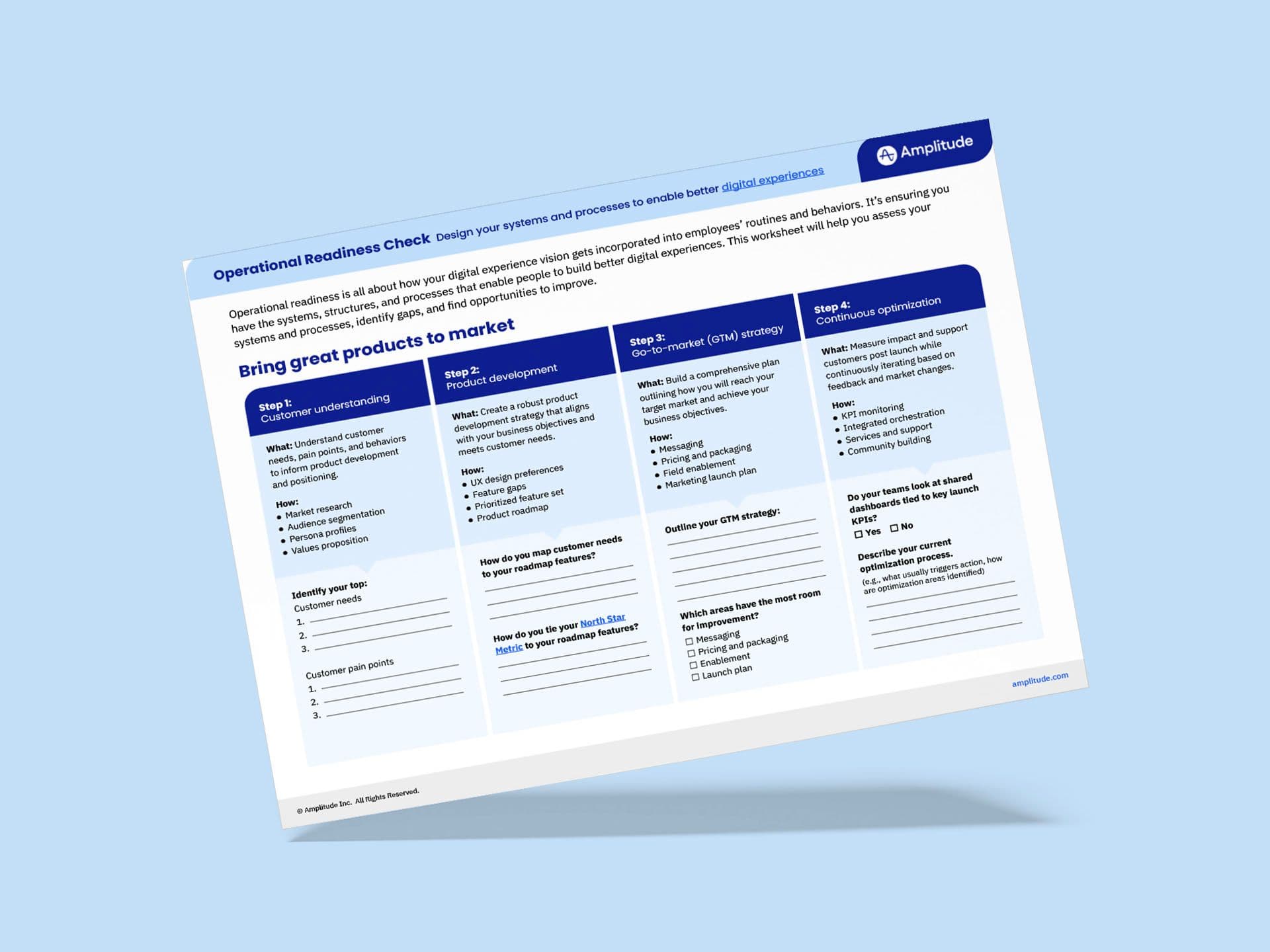
Pair the digital experience maturity assessment with the operational readiness worksheet.

Jenna Elliott
Vice President of Global Customer Success, Amplitude
Jenna Elliott is Vice President of Global Customer Success at Amplitude, where she ensures that customers are successfully implemented and drive business outcomes. She previously built Professional Services organizations at Narvar and Castlight Health.
More from Jenna


