Digital Experience Maturity: Creating Strategic Alignment
Learn how strategic alignment drives digital experience maturity and discover best practices for achieving it.


Trying to do anything without strategic alignment is a recipe for chaos. Teams chase conflicting priorities, duplicate efforts, or miss critical opportunities. Marketing campaigns fall flat because they don’t match product strategies. And new technologies are rolled out but fail to deliver value without the right operational support. The consequences are costly: wasted resources, frustrated employees, and dissatisfied customers.
Most importantly, without strategic alignment, your organization will struggle to achieve digital experience maturity. Consistently delivering exceptional digital experiences—the kind that today’s customers expect—is an ongoing journey that requires every part of your organization to move in sync.
To help organizations on this journey, we’ve developed a comprehensive Digital Maturity Model with an interactive maturity assessment. This model helps businesses evaluate their current state, pinpoint growth opportunities, and chart a clear path forward.
Every organization operates at some level of digital maturity. The key difference lies in how well they perform across the areas that matter most. Our model evaluates digital experience maturity based on four pillars:
- Strategic Alignment
- Organizational Readiness
- Operational Readiness
- Technology Readiness:
We recommend starting with strategic alignment. The more alignment you have at the start, the easier it will be to mature across the other pillars later.
In this piece, we’ll explore strategic alignment and give you actionable advice on how to set your organization up for success.
Key takeaways
- Digital experience maturity begins with strategic alignment, enabling progress across organizational, operational, and technology readiness.
- Strategic alignment involves a shared company vision and measurable goals that improve collaboration and decision making.
- Data-driven decision making supports strategic alignment, ensuring actions align with organizational goals.
- Clearly defined use cases tied to business outcomes help teams focus on solving impactful, measurable problems.
- Strategic alignment encourages a customer-centric approach, where every initiative prioritizes exceptional experiences.
What is strategic alignment, and why does it matter?
Strategic alignment is when your organization has a shared vision of success. It’s not just about setting goals—it’s about ensuring every team is working toward those goals with clear, measurable key performance indicators (KPIs) and performance tracking strategies. This creates a roadmap for progress that everyone can follow.
For organizations striving to enhance their digital maturity, strategic alignment is essential. It helps teams understand not only what they’re working toward but also how their roles contribute to the bigger picture. Without alignment, advancing in other key areas of digital maturity, like organizational, operational, and technology readiness, becomes significantly harder. “If companies find operational or technology readiness complicated, it’s because they haven’t executed on strategic alignment or organizational readiness correctly,” says Adam Greco, former Amplitude product evangelist.
Alignment starts at the top. When the C-suite is unified around strategic goals, these priorities can cascade seamlessly through every level of the organization. This top-down clarity empowers teams to focus their efforts, avoid conflicting priorities, and drive impactful digital initiatives forward.
The building blocks of strategic alignment
A strategically aligned company operates like a well-orchestrated team, where every action contributes to shared goals. Here’s what it takes to achieve strategic alignment.
A shared company vision
In a strategically aligned company, everyone—from executives to individual contributors—understands the company’s purpose, goals, and values. For companies focused on digital excellence, this includes a clear, digital-first roadmap that charts the path to long-term success.
This shared vision keeps teams focused and coordinated. It ensures that every effort, big or small, contributes to delivering standout digital experiences. When team members know exactly what the organization is trying to achieve and why it matters, they can align their actions to drive meaningful results.
Use cases and metrics that roll up to the shared vision
Strategic alignment thrives on clarity—and well-defined use cases give teams clear, actionable problems to solve. Use cases define specific, measurable objectives tied to business outcomes. For example, rather than vague goals like “improve customer experience,” you aim to “increase multi-device engagement by 20% by syncing functionality across platforms.”
In the context of digital experience maturity, these use cases are the building blocks of an organization’s digital experience strategy. They might focus on:
- Enhancing customer interactions by incorporating personalized recommendations
- Platform optimization by improving website performance or integrating new tools
- Organizational efficiencies by automating manual workflows or improving cross-team collaboration
Teams can then track use case progress with specific KPIs such as onboarding completion rate or session frequency. Real-time analytics tools like Amplitude provide instant visibility into progress. Accountability is shared across the organization, with each team member understanding how their specific tasks—whether designing a user interface, optimizing a workflow, or analyzing data—directly support the company vision.
A commitment to data-driven decisions
Data is the backbone of decision making in a strategically aligned organization. Leaders trust data over intuition, and this belief spreads throughout the company. Teams have access to the insights they need to guide their choices. They take action based on data points directly tied to the organization’s goals and vision.
How to achieve strategic alignment
Strategic alignment is more than just getting all your stakeholders in the same room at the same time and hoping for the best. True alignment requires leaders and teams to agree on specific, detailed goals and clearly define how success will be measured. Here are best practices to guide this process.
1. Bring together leaders from key functions
Strategic alignment begins with the right people. Include leaders from key functions such as product, marketing, sales, customer success, data, operations, and finance. Without their buy-in, digital transformation efforts often stall.
In-house leaders with digital transformation expertise are especially valuable and preferable to hiring short-term help from outside consultants. They can serve as project sponsors, rallying the organization around the long-term vision.
To unite these leaders, clarify why alignment is necessary. Articulate that meeting business goals—such as improving customer experiences or streamlining operations—requires collaboration. Use focused sessions with targeted questions and reflection exercises to evaluate how aligned you are:
- Are all teams aligned on annual and quarterly objectives?
- Do leaders agree on the role of digital experiences and data in achieving these goals?
- Have shared metrics, like a North Star Metric, been defined?
Alignment isn’t just a one-time exercise. It’s important to set leaders up for ongoing collaboration by:
- Establishing a committee that’s responsible for overseeing the implementation of digital maturity initiatives and maintaining strategic alignment
- Creating shared dashboards for key metrics
- Setting up communication tools (e.g., a Slack channel) for continuous updates
2. Define your North Star Metric and use cases
The next step is to define your North Star Metric (NSM). Your NSM serves as your team’s primary measure of success because it links the customer problems your team is addressing to the revenue outcomes your company seeks to achieve.
Once you know what success looks like at a high level, identify the specific business or customer problems (use cases) that will help you reach your NSM. Most people start with “What data do we want to collect?” and then look at all the data and think, “OK, what questions can we answer?” Instead, ask, “What questions do we need answered to solve our most important challenges and use cases?” Then determine what data is required to answer those questions.
The problems you’ll want to prioritize depend on how your company makes money. For example, companies playing the attention game focus on maximizing the time users spend engaging with their product. Those in the transaction game prioritize helping users make confident purchase decisions. Companies playing the productivity game aim to simplify and streamline workflows or tasks. Define your use cases based on your business model to make sure you’re solving the right problems to drive value for your customers and your revenue.
Learn more about defining and using a NSM in the North Star Playbook.
Let’s say your NSM is the number of new users who complete a key action like creating a new project within the first 14 days. A use case might focus on identifying friction points in your product’s onboarding process. The business questions could include:
- Which acquisition channels or campaigns bring in users most likely to activate?
- What does the onboarding funnel look like, and where do most users drop off?
- Which specific features or steps correlate with higher activation rates?
From there, you’d collect and analyze data on user sign-ups, funnel drop-offs, time to activation, and qualitative feedback from users. Aligning around this NSM and related use cases ensures that cross-functional teams—such as product, marketing, and customer success—work toward the same goal.
3. Get inspiration from industry success stories
Motivate your team by sharing industry success stories. These examples prove that strategic alignment works and can help your organization achieve similar results, such as growth in key retention and conversion metrics. To make the examples more relevant, apply your company’s numbers to their outcomes to calculate hypothetical future outcomes if you experience similar success.
Luni, a leading mobile app publisher, faced a challenge familiar to many organizations: plenty of data but little actionable insight. When Adrien Dulong joined as Chief Operations Officer and Chief Product Officer, he set out to ensure teams could make better decisions. Achieving this demanded organizational alignment and a cultural shift.
Adrien’s first step was creating shared goals and standardizing key metrics like retention and trial-to-paid conversions. This alignment gave teams a common framework to measure success. Luni also fostered a culture of experimentation, encouraging teams to test their ideas.
As part of this transformation, 60% of Luni employees became active Amplitude users. They use Amplitude as a source of truth for their shared goals and to run experiments that drive real business results. The team has since seen revenue improvements and a 10% boost in conversion rates.
Achieving digital maturity takes time and requires organization-wide change. That’s why the next pillar, organizational readiness, focuses on preparing teams and processes to support long-term transformation.
Are you ready for change?
Start building the alignment you need for long-term digital maturity. Take the digital experience maturity assessment to understand where your organization stands today and how you can improve. You’ll receive personalized recommendations to serve as the perfect starting point for your strategic alignment work.
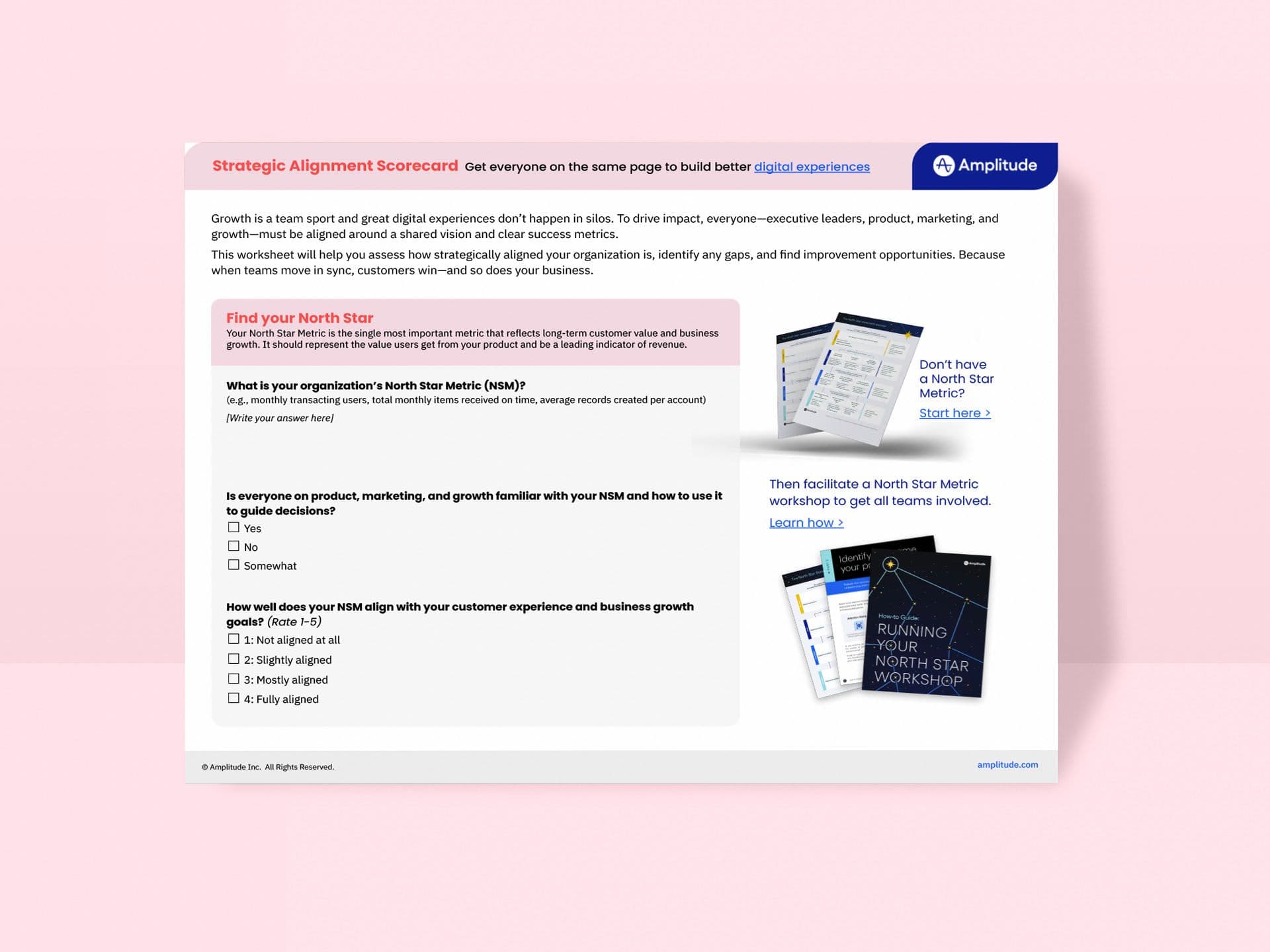
Pair the digital experience maturity assessment with the strategic alignment worksheet.

Jenna Elliott
Vice President of Global Customer Success, Amplitude
Jenna Elliott is Vice President of Global Customer Success at Amplitude, where she ensures that customers are successfully implemented and drive business outcomes. She previously built Professional Services organizations at Narvar and Castlight Health.
More from Jenna


