How AI took the data analyst’s job, and created a better one
AI handles the mundane tickets and monitoring. Analysts focus on directing AI and digging deeper.


For decades, data teams held the keys to the data castle. All requests went through them; no meaningful data discoveries happened without them. AI has completely changed that. Business users can now use AI to run complex analyses, investigate root causes, build dashboards, flag problems, and more on their own. That means fewer tickets, less waiting, and faster decisions.
What does that mean for data science teams? There’s been a lot of discussion on this topic online (see the post below), and while there are differing opinions, one thing is clear: the role is changing and expanding, and in our opinion, it’s shifting for the better.
From data execution to strategic planning and AI guidance. Less time on data cleaning and manual dashboard creation; more time on decision framing, stakeholder guidance, and business strategy.
To validate our perspective and understand how this shift is actually coming to life, we spoke with AI early adopters (who also happen to be Amplitude customers) to get their takes. Here are four ways AI is changing the data analyst role and what they’ve learned so far.
- What are data teams actually doing differently as a result of AI?
- What use cases are they seeing the most success with?
- What have they learned, and what would they do differently?
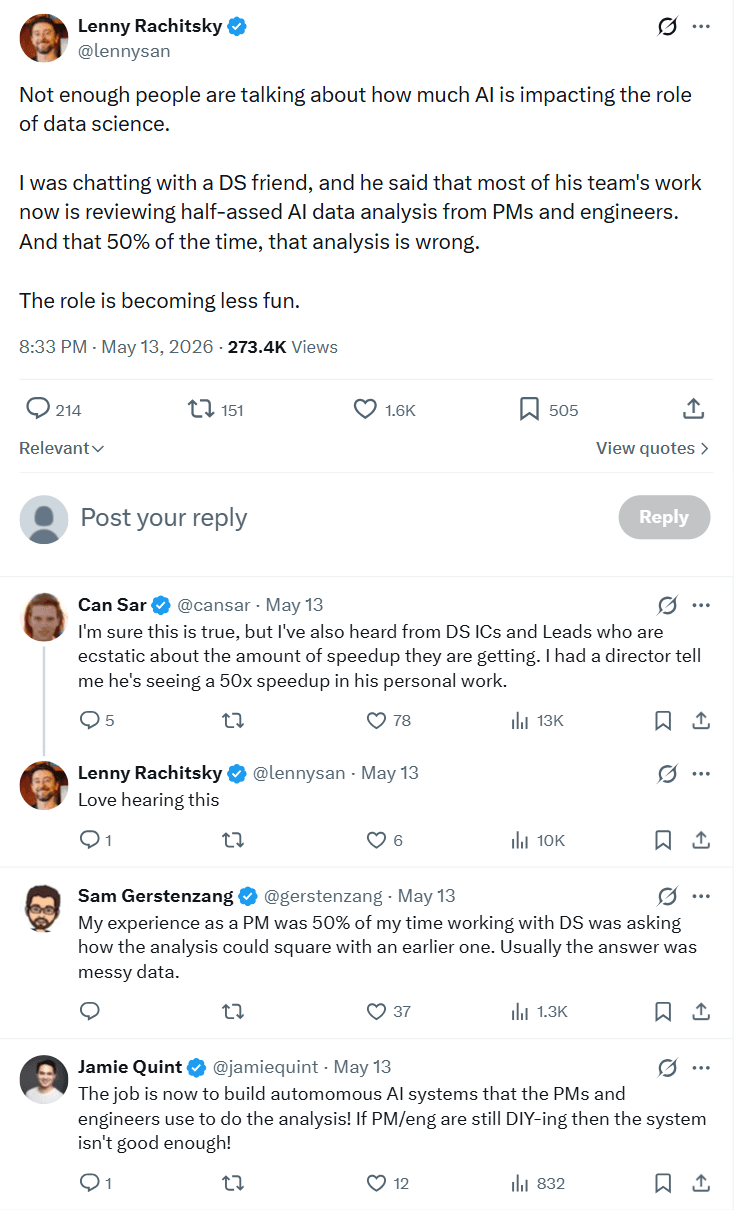
Lenny thinks AI is making the data science role less fun. We think it’s making it better. What do you think?
1. Analysts shift from ticket takers to AI orchestrators
For most organizations, data analysts are the gatekeepers to insights. If a product manager wants to understand a funnel, they submit a ticket. If an engineer needs a quick number, they ask the data team. The backlog grows, and decisions slow.
AI is changing that by expanding who can get answers on their own. This means analysts spend less time querying data and more time orchestrating AI to empower business users.
Take the team at Smartsheet.
Smartsheet is an intelligent work management platform that unites people, data, and AI to turn strategy into measurable enterprise impact. In the past, product teams were entirely reliant on data teams for insights. “We dealt with long backlogs, shifting priorities that put requests on the back burner, and a lot of swirl,” says Principal Product Data Operations Manager Haytham Akremi. “It slowed decision-making considerably.”
Now, Smartsheet PMs, engineers, designers, and researchers use Amplitude AI daily to track engagement, retention, and how users accomplish tasks with their product. A simple funnel analysis of a new feature, which previously took weeks of waiting on a backlog for manual SQL analysis, is now instant.
This leaves more time for data teams to govern how AI systems access and interpret data, improve experimentation frameworks, define trusted metrics, and guide teams toward better decisions. When data analysts stop being order-fillers, they can start being interpreters, advisors, and drivers of strategic work.
“As Smartsheet invests in AI to transform how people and organizations amplify work, the stakes for understanding user behavior only get higher.”
Haytham Akremi, Principal Product Data Operations Manager, Smartsheet
2. AI handles monitoring, so data teams don’t have to
Actions multiply with AI. Teams can run experiments and iterate at a speed and volume previously unimaginable. This means more insights and results than ever before—and added pressure on teams to track and make sense of it all. Plus, as experimentation accelerates, another issue emerges: Humans can’t monitor everything all the time.
The team at Palo Alto Software, which builds products like LivePlan for entrepreneurs, is always testing. These experiments generate hundreds of actions on the platform on a typical day and touch millions of events over a 90-day period. “Having access to this data gives us clarity, but it also creates a lot of pressure,” says Data and Strategy Analyst Shawn Hymer. “When experiments multiply, insight can easily lag behind execution. And at our scale of experimentation, keeping track of critical test results was starting to give every day the stress of coming back from a 2-week vacation.”
His team was spending a lot of time manually monitoring dashboards and scanning charts, trying to piece together what had changed. Which experiment caused this shift? Is the drop meaningful?
Amplitude AI Agents changed that posture. Instead of reactive scanning, teams now start with questions: Explain this chart. Why are users dropping off here? What is driving this spike? Agents handle continuous monitoring and surface anomalies automatically, all the time: nights, weekends, and during busy testing cycles when no one is actively watching. Agents also summarize changes across key dashboards, monitor critical flows, and automatically surface anomalies.
AI reduces the cognitive load for data teams.
“We still rely on rigor. We still validate results. We still debate what the data means. What has changed is that insight keeps up with execution.”
Shawn Hymer, Data and Strategy Analyst, Palo Alto Software
3. Data teams spend more time validating AI outputs
Teams across all levels and functions can now use AI to generate insights, run analysis, and produce outputs. But they still need a human with context and institutional knowledge to verify AI results before pushing to production. Enter the data team.
At NTT DOCOMO, Japan’s largest mobile carrier with more than 100 million customers, data teams have used AI agents to give everyone access to insights and fuel action across the organization. Product and marketing teams can now quickly analyze funnels and drop-offs and collaborate across teams without analyst queue bottlenecks. They can also engage with dashboards, asking natural‑language questions and having an AI agent scan relevant data points, summarize campaign performance, and highlight unusual movements and likely drivers.
“Before Amplitude, extracting insights from our vast data pools often required specialized expertise. Teams had to wait for analysts or rely on limited experts, which created bottlenecks between data and action.”
Takashi Suzuki, SVP, General Manager of Data Platform Department, NTT DOCOMO
This means DOCOMO’s data analysts now spend less time providing functional partners with answers and more time validating and discussing AI-generated insights. How? Data platform teams embedded agents into existing review cycles and use them to run cross-dashboard investigations and generate weekly summaries that previously required manual deep dives.
As AI accelerates access to insights, data teams become the critical layer that ensures speed doesn’t come at the expense of accuracy, context, or trust.
4. Analysts have more time to dig deeper
There’s a common trait amongst data analysts: curiosity. Most didn’t happen into their roles because they love numbers; they love to explore and find answers to the tricky questions most of us wouldn’t think (or care) to ask. Every analyst knows the feeling of a number that could lead to an exciting discovery, but when most of their time is spent on data tickets, they rarely have the time to chase it.
With AI doing the mundane manual work, analysts now have time to dig deeper and satisfy those investigative instincts.
“Dissecting data to satisfy our curiosity has unlocked valuable—sometimes unexpected—insights we couldn’t access through previous formal data requests,” explains Smartsheet’s Haytham.
Shawn of Palo Alto Software echoes a similar sentiment. “Amplitude AI does not remove complexity—it helps teams navigate it without cutting corners.”
AI reduces mental overhead and helps data teams focus on the complex questions that actually deserve attention. This means more interesting, exciting, and fulfilling days for data analysts.
Become an AI-empowered data analyst
Whether you think AI is making the data analyst role better or worse, you can’t contest that the role is changing. The data teams at Smartsheet, Palo Alto Software, and NTT DOCOMO illuminate a common thread: the analyst who thrives isn’t the one who fights the AI shift. It’s the one who leans into the new division of labor.
Let AI handle the mundane tickets and monitoring. Focus your attention on directing AI and digging deeper. Put AI to work for you.

Chris Van Wagoner
Former Director, Customer Advocacy and Community, Amplitude
Chris Van Wagoner led Customer Advocacy and Community at Amplitude, partnering with enterprise brands to improve activation, retention, and product experimentation through shared customer insights.
More from ChrisRecommended Reading

Lessons from consolidating our MCP server
Oct 6, 2026
10 min read

What AI engineers do in the age of agentic code
Oct 1, 2026
14 min read

An analysis of Jev: Faster and cheaper, but watch the accuracy
Sep 28, 2026
13 min read

Your agent isn’t broken. It’s guessing.
Sep 23, 2026
6 min read